
Quackgrass
Releases chemicals that suppress surrounding grass growth (allelopathic). Rhizomes physically displace grass roots. Forms expanding patches of coarse-textured grass. Any rhizome fragment as small as 1 inch can regenerate.
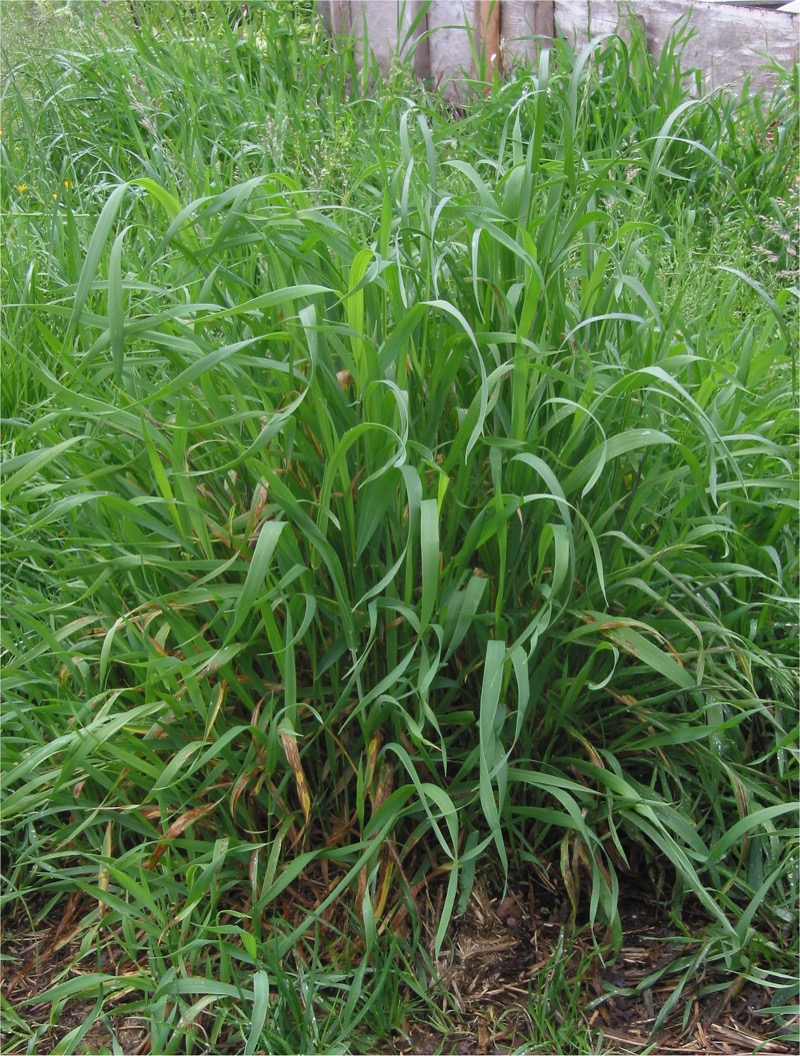
Growth Habit
Coarse, wide blades with clasping auricles at leaf base. Spreads aggressively through underground rhizomes that can penetrate 4+ inches deep and push through compacted soil.
Pre-Emergent Control
None effective. Quackgrass spreads primarily through rhizomes, not seeds.
Post-Emergent Control
No selective herbicide kills quackgrass without killing cool-season turfgrass. Only option is spot-treatment with glyphosate (non-selective) then reseed.
Overview
Quackgrass (Elymus repens) is a creeping perennial grassy weed that spreads through an aggressive underground rhizome network. It is one of the most difficult lawn weeds to control because no selective herbicide can kill it without also killing cool-season turfgrass.
Identification
Coarse, wide grass blades that are noticeably different in texture from surrounding turf. The key identifying feature is clasping auricles (small claw-like projections) at the base of each leaf where it meets the stem. Rhizomes are thick, white, and pointed.
Damage to Your Lawn
Quackgrass uses multiple competition strategies. It releases chemicals that suppress the growth of surrounding grass (a trait called allelopathic). This is why the area around a quackgrass patch often looks thin and stressed even before the quackgrass visibly spreads. Its rhizomes also physically displace grass roots as they push through the soil. Any rhizome fragment as small as 1 inch can regenerate a new plant.
Why It Is So Hard to Control
Quackgrass and cool-season turfgrasses are too closely related biologically for any selective herbicide to distinguish between them. Any rhizome fragment as small as 1 inch left in the soil can regenerate a completely new plant.
Control Strategy
The only effective approach is spot-treatment with glyphosate (non-selective), which kills everything it contacts, followed by reseeding the treated area. For isolated clumps, this is straightforward. For large infestations, a full lawn renovation may be necessary.
Digging out rhizomes manually is extremely labor-intensive and rarely successful long-term unless every fragment is removed.
Recommended Products
Affiliate disclosure: we may earn from qualifying purchases.
2,4-D + Dicamba + Mecoprop
Dandelions, clover, plantain, chickweed, and most common broadleaf weeds
$20-40