
Creeping Charlie
Forms dense, ground-hugging mat that completely smothers grass. Stolons weave through grass making mechanical removal extremely difficult. Thrives in shade where grass is already thin, then expands into sunny areas.
Growth Habit
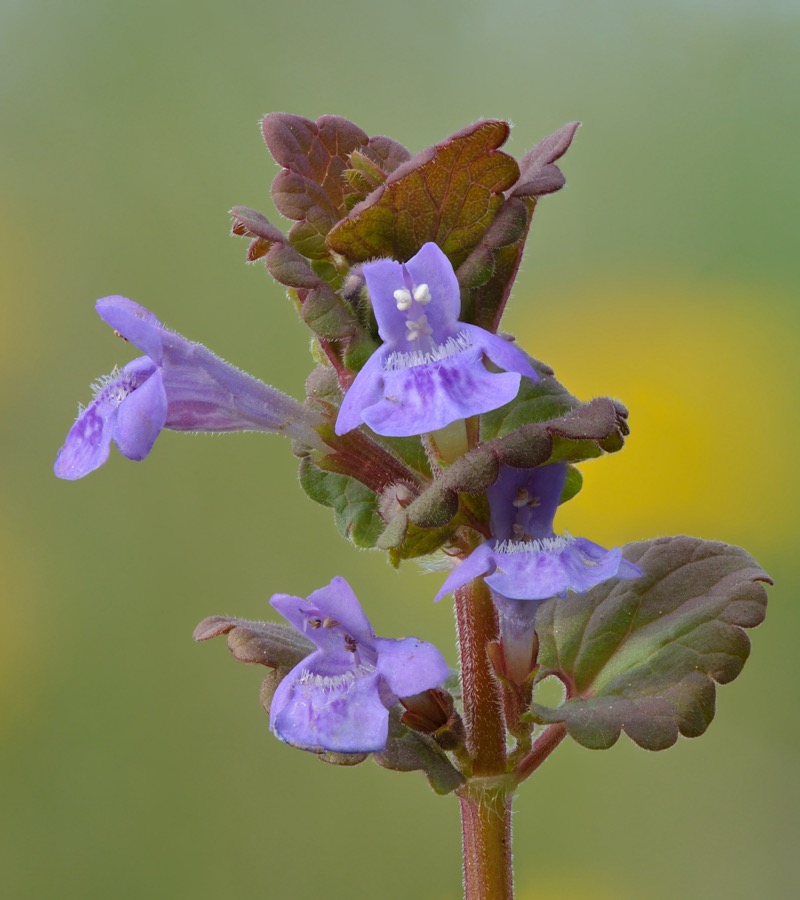
Low-growing vine with scalloped, kidney-shaped leaves and small purple flowers. Spreads by stolons that root at every node. Also spreads by seed.
Pre-Emergent Control
Limited effectiveness. Isoxaben provides some suppression. Not a reliable pre-emergent target.
Post-Emergent Control
Triclopyr is the go-to. Apply in fall when plant actively sends nutrients to root system. May need 2 applications 3 weeks apart.
Overview
Creeping Charlie (Glechoma hederacea), also known as ground ivy, is widely considered the most frustrating lawn weed. It is a creeping perennial broadleaf that spreads aggressively via stolons (above-ground runners) that root at every node, making it nearly impossible to eradicate mechanically.
Identification
Look for low-growing vines with scalloped, kidney-shaped leaves arranged in opposite pairs. Small purple tubular flowers appear in spring. Stems are square (a mint family characteristic). Crushed leaves have a minty smell.
Damage to Your Lawn
Creeping Charlie forms a dense, ground-hugging mat that completely smothers turfgrass. Its stolons weave through grass blades and root at every node, creating an interconnected network. It thrives in shade where grass is already thin, then expands aggressively into sunny areas.
Why It Is So Difficult to Control
Aggressive stolon spreading combined with shade tolerance and difficulty of removal makes creeping Charlie the lawn care community’s most-despised weed. Standard 3-way herbicide (2,4-D alone) has mixed results. Any stolon fragment left behind regrows into a new plant.
Control Strategy
Triclopyr is the primary chemical control. Apply in fall when the plant is actively sending nutrients to its root system — the herbicide translocates down with those nutrients. Expect to need 2 applications spaced 3 weeks apart. Can be tank-mixed with 2,4-D for broader broadleaf control.
For severe infestations covering large areas, full renovation (glyphosate kill + reseed) may be more practical and cost-effective than years of spot treatment.
Recommended Products
Affiliate disclosure: we may earn from qualifying purchases.
Triclopyr
Creeping charlie (ground ivy), clover, wild violet, oxalis, English ivy
$15-30
2,4-D + Dicamba + Mecoprop
Dandelions, clover, plantain, chickweed, and most common broadleaf weeds
$20-40