
Dollarweed
Forms colonies in wet, shaded areas of warm-season lawns. Spreads aggressively through underground rhizomes in over-irrigated or poorly drained soil. Bright green patches disrupt turf uniformity.
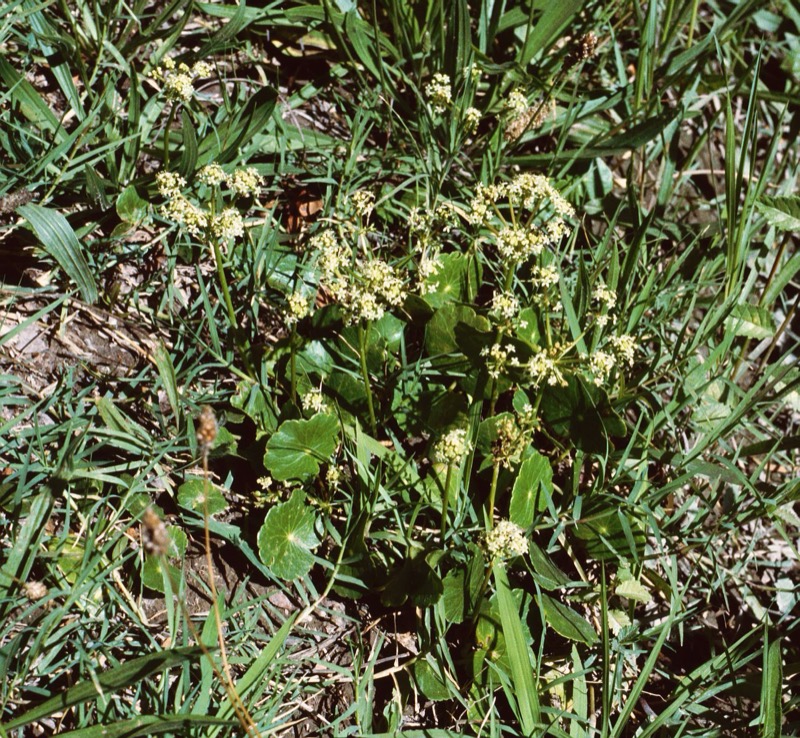
Growth Habit
Round, bright green leaves (silver-dollar shaped) on long petioles attached at the center of each leaf (peltate). Spreads by rhizomes and tubers through moist soil.
Pre-Emergent Control
Pre-emergents are generally ineffective since dollarweed spreads primarily through rhizomes and tubers.
Post-Emergent Control
Atrazine (in tolerant grasses). Triclopyr or 3-way broadleaf herbicide. Metsulfuron-methyl for resistant populations.
Overview
Dollarweed (Hydrocotyle spp.), also known as pennywort, is a creeping perennial broadleaf weed that thrives in wet, warm conditions across zones 7-10. It is one of the most common weed complaints in Florida and Gulf Coast lawns, and its presence is almost always an indicator of overwatering.
Identification
Round, bright green leaves shaped like silver dollars, each about 1-2 inches in diameter. The stem (petiole) attaches at the center of the leaf, not the edge (called peltate attachment — like a small umbrella). Leaves are smooth, waxy, and scalloped around the edges. Small white flowers appear in clusters.
Damage to Your Lawn
Dollarweed forms expanding colonies in moist, shaded areas of warm-season lawns. It spreads aggressively through underground rhizomes and tubers in over-irrigated or poorly drained soil. Bright green patches of round leaves are visually disruptive against the linear blades of bermuda or St. Augustine.
Control Strategy
Reduce irrigation first. Dollarweed is a moisture-loving plant, and its presence is the strongest indicator that you are overwatering. Switching to deeper, less frequent irrigation (following Rule 7.1 guidelines) often reduces dollarweed pressure significantly without any herbicide.
For chemical control, atrazine is effective in tolerant grasses (centipede, St. Augustine). Triclopyr or a 3-way broadleaf herbicide works in other warm-season grasses. Metsulfuron-methyl is used for resistant populations.
Improving drainage in affected areas (core aeration, topdressing with sand) addresses the root cause and provides lasting control.
Recommended Products
Affiliate disclosure: we may earn from qualifying purchases.
Atrazine
Broadleaf and crabgrass control in centipede and St. Augustine lawns
$15-25
Triclopyr
Creeping charlie (ground ivy), clover, wild violet, oxalis, English ivy
$15-30
2,4-D + Dicamba + Mecoprop
Dandelions, clover, plantain, chickweed, and most common broadleaf weeds
$20-40